

The "Uncontrolled Risk" Fear: How to Engineer Safe, Predictable Voice AI
In boardroom discussions about adopting Voice AI, the conversation almost always follows a predictable pattern. First, there is amazement at the demo: "It sounds incredibly human."
But then, the mood shifts. A CEO or Compliance Officer leans forward and asks the uncomfortable question: > "Sure, it sounds real. But can I trust it with my brand? What if it hallucinates? What if it promises a discount we can't give? What if it wastes money chatting about the weather?"
This is the Uncontrolled Risk Fear. And frankly, it is a valid concern.
For decades, businesses fought against the "Old IVR Trap"—systems so rigid they forced customers to scream "AGENT!" just to escape. But now, leaders fear the "New Trap": The Over-Creative AI. An agent that is so fluent, it drifts off-topic, makes up facts, or forgets it is representing a business.
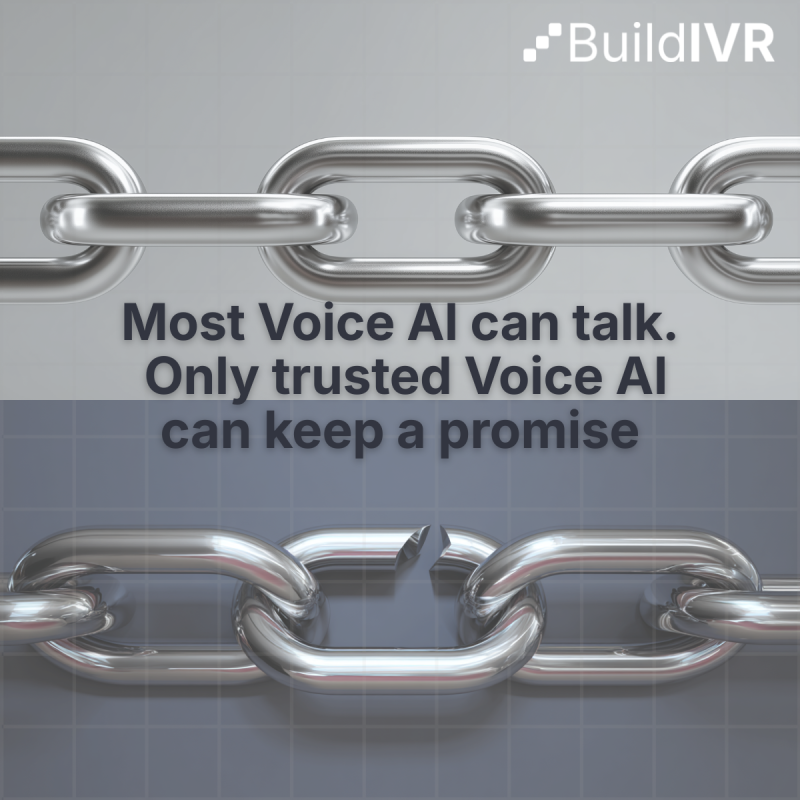
At BuildIVR, we believe that for Enterprise use, sounding human is just the baseline. The real product is CONTROL.
Here is how we turn unpredictable AI models into safe, compliant business assets.
It’s Not Magic. It’s Instruction Engineering.
Many leaders mistakenly believe that once you turn on an LLM (Large Language Model), you surrender control to the "black box."
The reality is different. We don’t just unleash a raw model onto your phone lines. We engineer strict System Prompts—complex, multi-layered sets of instructions that act as the agent’s operational laws. Think of it as a rigid constitution that the AI cannot violate, no matter what the caller says.
Here are the four pillars of safety we build into every agent:
1. The Anti-Drift Protocols
Real humans get distracted. AI shouldn't. One of the biggest fears is that an AI agent will get drawn into irrelevant conversations—politics, competitors, or personal advice.
We program explicit Scope Boundaries. The agent is instructed on exactly what falls outside its job description.
- Scenario: A caller asks, "What do you think about the election?" or "How do I bake a cake?"
- The Protocol: The AI acknowledges the input but immediately pivots: "I'm afraid I can't help with that, but I can definitely help you reschedule your appointment. Would you like to do that?"
It politely but firmly steers the ship back to business.
2. Reputation Guardrails
Brand reputation takes years to build and seconds to ruin. We define Negative Constraints—a list of behaviors the AI is strictly forbidden from doing.
The AI knows it cannot:
- Authorize discounts that aren't in the database.
- Use slang or offensive language, even if the caller does.
- Speculate on legal or medical advice.
- Mention competitors by name.
By defining what the AI cannot do, we create a safe playground for what it can do.
3. The Token Economy (Cost Control)
A chatty AI isn't just annoying; it's expensive. Every extra word costs money in API tokens and telecommunications fees.
We engineer prompts for Conciseness and Efficiency.
- Bad AI: "Oh, I see you want to book a table. That is wonderful, we love having guests on Fridays! Let me just check the system for you..."
- BuildIVR Agent: "I can help with that. For how many people?"
The agent respects the customer's time and protects your API costs. It doesn't waffle. It gets the job done.
4. Escalation Logic (The Safety Net)
The mark of a safe system isn't that it knows everything—it's that it knows what it doesn't know.
We program Confidence Thresholds. If the AI encounters a complex edge case, an angry customer, or a query it doesn't understand, it is strictly forbidden from guessing.
Instead, it triggers a Graceful Handoff: "I want to ensure this is handled perfectly for you, so I am going to connect you with a specialist who can resolve this immediately."
This isn't a failure. It’s a safety feature.
The Bottom Line: Empathy + Compliance
The choice is no longer between "Robotic and Safe" vs. "Human and Risky."
With the right prompt architecture, you can have the best of both worlds. You get the empathy and fluidity of a human conversation, combined with the compliance and adherence to rules of a machine.
At BuildIVR, we don't just build voice bots. We build safe, controlled, enterprise-grade intelligence.
Ready to hear what "Safe AI" sounds like? https://www.buildivr.com/#demo or contact us to discuss your specific safety requirements.